
Energy, Power & Resources
By Cavendish2025 was dominated by geopolitical fragmentation reshaping global Energy and Resources markets. Volatility across commodities, policy intervention and shifting trade dynamics placed capital discipline firmly at the centre of strategic decision-making, as companies navigated increasingly complex operating conditions.
Across the sector, growth was uneven. Some commodities experienced record pricing, while others faced sustained oversupply. In response, M&A activity became more focused on diversification, consolidation and portfolio optimisation rather than greenfield expansion.
Energy: Diverging Regional Dynamics
The oil and gas sector experienced a challenging year in 2025, with oil prices falling by more than 20 percent and dropping below $60 as supply significantly outpaced demand.
In the UK, the extension of the Energy Profits Levy created profound fiscal uncertainty in the North Sea. The removal of investment allowances further dampened investor confidence, standing in sharp contrast to regions such as the Middle East and the Americas. In the Middle East, upstream investment exceeded $600 billion in 2024, while the US, Canada, Brazil and Guyana continued to drive global production growth, supported by more stable policy frameworks and mature service ecosystems.
For 2026, our attention in the oil and gas space will be on exploration, capital allocation and M&A. The threat of lower oil prices in 2026 will create capital allocation tension for companies as they look to balance shareholder returns against continued portfolio investment. Exploration is expected to gain renewed focus in 2026 as the supermajors and majors look to reverse years of underinvestment and offset declining reserve values. M&A will remain in the spotlight, driven by further consolidation in the UK North Sea and the U.S. and the rationalisation of portfolios by the supermajors. In the U.S, this M&A will pivot to gas as players look to capitalise on demand tailwinds – driven by an expected increase in gas demand from U.S. LNG and data centres. Looking to 2027, we expect to see a recovery in oil prices, driven by rising demand, delays in non-OPEC+ supply and shrinking OPEC+ spare capacity.
One of the most significant structural forces shaping the outlook is the rapid expansion of artificial intelligence.
AI is expected to more than double global data centre electricity demand by 2030, reaching levels comparable to Japan’s total electricity consumption and representing a 165 percent increase compared with 2023. The implications extend well beyond power generation. AI-driven data centres require materially higher copper intensity, using an estimated 2.5 to 3 times more copper per square foot than traditional facilities.
As a result, AI is emerging as a fundamental driver of energy markets, critical mineral demand, grid infrastructure investment and geopolitical competition for the resources underpinning the digital economy.
For UK businesses and domestic customers in 2026, the wholesale price of energy is not anticipated to lead to energy cost volatility, with wholesale commodity pricing now normalised after the high volatility of recent years. That said, the ever-increasing cost of upgrading energy infrastructure and pursuit of net zero targets will keep adding to consumer bills.
There is going to be an accelerating UK power and utility infrastructure upgrade drive throughout 2026. The UK government also recently held consultations towards the end of 2025 on potentially switching the renewable energy subsidy (specifically Renewables Obligation (RO) and Feed-in Tariffs (FiT)) inflation measure from Retail Price Index (RPI) to Consumer Price Index (CPI). The government’s aim is to cut costs for consumers. If changes are implemented, they would commence from April 2026, though renewable energy generation industry participants have expresses significant concerns about such a move, especially with any retrospective recalculations. This could have implications for industry cost of capital on new energy projects.
Resources: Copper, Gold and Critical Minerals in Focus
Precious metals were a defining feature of 2025, with gold and other metals reaching record highs. At the same time, critical minerals moved firmly to the forefront of government policy, driven by the need to underpin national defence, economic resilience and supply chain security.
Copper, lithium, rare earth elements and cobalt have become central to electrification and infrastructure investment, with governments expanding interventions ranging from tariffs to publicly backed venture capital for critical minerals projects. However, the market remains highly heterogeneous. While some commodities face tight supply, others are operating through sustained gluts, creating a complex pricing environment.
For 2026, our attention in the mining space will be on gold, copper and critical minerals. Our expectation is that gold prices will continue to be strong in 2026, underpinned by central bank buying and myriad geopolitico-economic concerns. Supply-wise, the sector a hotbed of M&A for some years, and we expect this trend to continue. Copper prices should also remain elevated, underpinned by structural supply constraints, a thin pipeline and sustained demand from electrification and infrastructure. Critical minerals will remain in the spotlight, with China’s actions highlighting just how vulnerable Western supply chains for these can be. That said, this is a highly heterogeneous category, and price performance will vary widely depending on the specific supply-demand situations of individual commodities.

Against this backdrop, Cavendish continued to build momentum across Energy, Power and Resources during 2025.
Client wins included Sintana Energy Inc and Touchstone Exploration Inc. Cavendish also initiated coverage on Pharos Energy, Rockhopper Exploration, YU Group and Europa Oil & Gas plc.
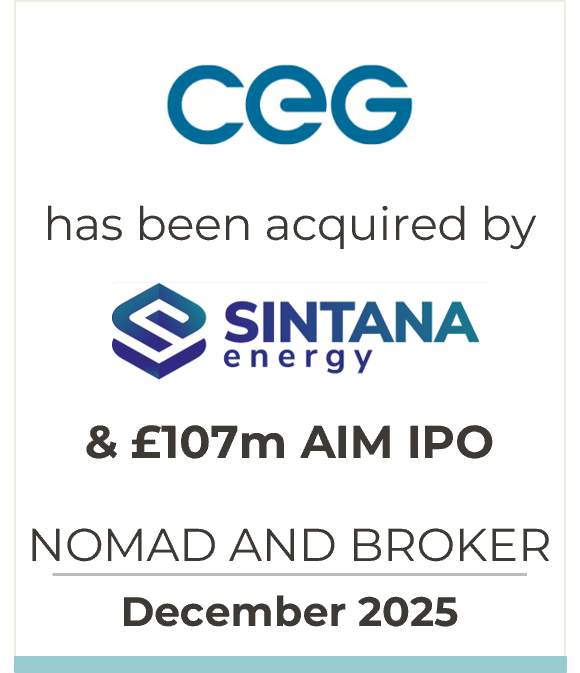
Recent transactions included acting as financial adviser to Sintana Energy Inc on its C$84 million recommended offer for Challenger Energy plc and its subsequent £107 million IPO on AIM. Further cross-border activity included advising Falcon Oil & Gas Limited on the C$239 million sale of its subsidiaries to Tamboran Resources Inc. Cavendish also continued to work with companies bringing enabling Energy Transition technologies to the market, most notably as nominated adviser and broker to Clean Power Hydrogen plc on its £7.4 million placing and retail offer, and Ilika plc on its £4.2 million placing and retail offer.
The Energy, Power & Resources team was further strengthened through strategic senior hires, with the appointments of James Midgley and Yuen Low as Equity Research Directors bringing their decades of experience in these crucial sectors.




As the sector moves into 2026, the interplay between geopolitics, capital discipline, AI-driven demand and supply chain security is expected to continue to define both strategic priorities and transaction activity.
Energy, Power and Resources businesses face an increasingly complex environment, but one where well-positioned assets, disciplined capital allocation and strategic M&A can play a pivotal role. Cavendish looks forward to supporting clients as they navigate these dynamics and pursue opportunities across the sector in the year ahead.
Get in touch with our Energy, Power & Resources team to find out more

Neil McDonald
Corporate Finance Managing Director

Derrick Lee
Corporate Finance Director

Pete Lynch
Corporate Finance Director

Pearl Kellie
Corporate Finance Associate

James McCormack
Research Director

Ian McInally
Research Director

James Midgley
Director, Research

Yuen Low
Director, Research

Iain Macarthur
Sales Director

Graham Hall
Sales Associate Director

Anne Cassels
Investor Relations Associate

Hannah Smith
Investor Relations Assistant / Office Manager